
Managing the Rental Process for Heavy Machinery: A Practical Guide for SMBs
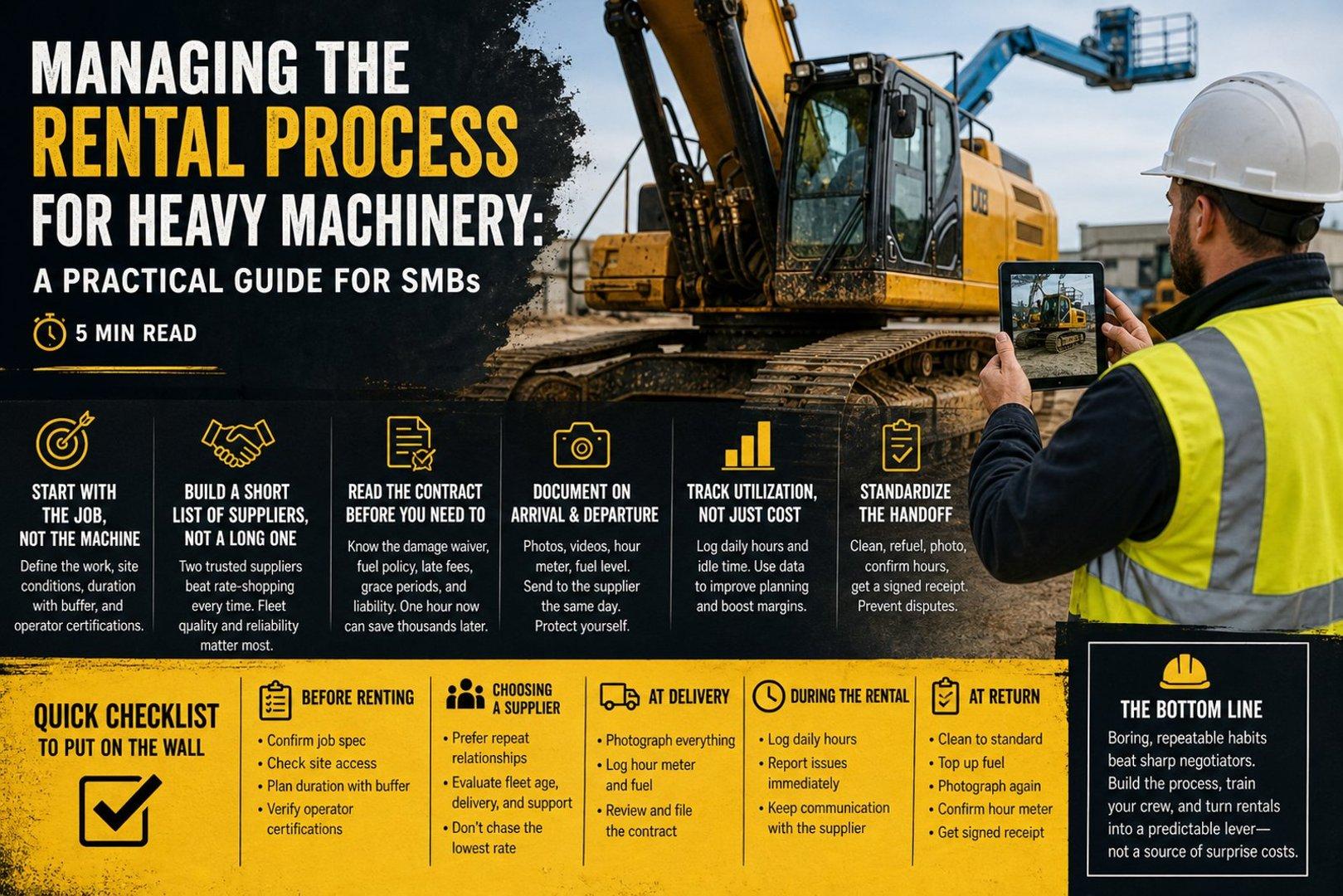
For small and mid-sized businesses in construction, landscaping, agriculture, or industrial services, owning every piece of heavy equipment rarely makes financial sense. A telehandler used twice a year, a mini excavator needed only for a specific job, or a boom lift required for a single building maintenance cycle — these are textbook rental candidates. Yet the rental process itself, when handled informally, quietly drains margins. Late returns rack up surcharges, damage disputes turn into invoicing battles, and the wrong machine on-site costs a full day of crew time.
Managing rentals well is less about negotiating the cheapest rate and more about building a repeatable process. Here's how to think about it.
Start with the job, not the machine
The most common rental mistake is starting with what's available rather than what the job actually requires. Before you call a single supplier, the project lead should be able to answer four questions: What needs to be done? What are the site conditions (terrain, access width, overhead clearance, indoor or outdoor)? How long will the equipment realistically be needed, including weather buffer? And who on the crew is certified to operate it?
That last question matters more than people expect. Renting a piece of equipment your team isn't licensed or trained to use means either paying for an operator on top of the rental, or letting the machine sit idle while someone gets certified. Both scenarios destroy the economics of the rental in the first place.
Build a short list of suppliers, not a long one
SMBs often try to play three or four rental yards against each other on every job, hoping to squeeze out the best rate. In practice, this is a false economy. The real savings come from being a known, repeat customer at two trusted suppliers — one primary, one backup. Repeat customers get faster delivery slots, more flexibility on returns, better damage-waiver terms, and access to newer fleet units. They also get phone calls when something they typically rent comes back early at a discount.
Pick suppliers based on fleet age, delivery reliability, and how they handle disputes — not just hourly or daily rates. A rate that's fifteen percent lower means nothing if the machine arrives four hours late or breaks down on day two with no replacement available.
Read the contract before you need to
Rental agreements are where small businesses get hurt. The language around damage waivers, fuel policies, hour meters, environmental fees, and late-return charges is rarely standardized across suppliers. Before signing anything, you should know exactly:
- What counts as "normal wear" versus chargeable damage
- Whether the damage waiver covers theft, vandalism, and tire damage, or excludes them
- How fuel is reconciled at return
- What the grace period is on returns and what the overage rate looks like
- Who is liable if the machine fails through no fault of yours
Spend an hour once per supplier going through their standard agreement with someone who will actually be managing rentals on the ground. That hour pays for itself the first time a dispute comes up.
Document the machine on arrival and departure
This is the single highest-leverage habit in the entire rental process, and it costs nothing. The moment a machine arrives on site, walk around it with a phone and take time-stamped photos and a short video — every panel, the tires or tracks, the hour meter, the fuel gauge, the cab interior, and any existing dents or scratches. Send the file to the supplier the same day with a brief note: "Received [machine ID] at [time], condition documented, see attached." Do the same on return.
When a damage charge appears on an invoice three weeks later, you have evidence. Without it, you have an argument you'll usually lose.
Track utilization, not just cost
Most SMBs track what they spend on rentals. Far fewer track how much of the rental period the machine was actually working. If you rented a skid steer for five days and it ran for sixteen hours total, you paid for idle time — either because the job was poorly sequenced, the wrong machine was specified, or weather killed two days you should have anticipated.
A simple log — daily hour-meter readings, hours actually worked, reason for any idle time — turns rental cost from a line item into a learning loop. After a few months, you'll see patterns: certain job types consistently overrun, certain crews underuse equipment, certain machines are routinely the wrong call. That's where real savings live.
Standardize the handoff
The last hour of a rental is when most disputes happen. Standardize it. The crew member returning the machine should clean it to a documented standard, top up fuel per the contract, photograph it again, confirm the hour meter reading with the supplier's driver or yard staff in writing, and get a signed return receipt. None of this is exciting, but a five-minute handoff prevents five-week invoice fights.
A quick checklist to put on the wall
- Before renting: confirm job spec, site access, duration with buffer, and operator certifications.
- Choosing a supplier: prefer repeat relationships over rate-shopping.
- At delivery: photograph everything, log hour meter and fuel, file the contract.
- During the rental: log daily hours and any issues immediately.
- At return: clean, refuel, photograph, get a signed receipt.
The bottom line
Heavy equipment rental is one of the few areas in an SMB's operations where small process improvements compound into meaningful margin. The businesses that do this well aren't the ones with the sharpest negotiators — they're the ones with the most boring, repeatable habits. Build the habits once, document them, train the crew on them, and the rental process stops being a source of surprise costs and starts being a predictable lever you can pull whenever a job calls for it.