
Mascus vs OTOMOTO vs MachineryZone: Where European Dealers Should List
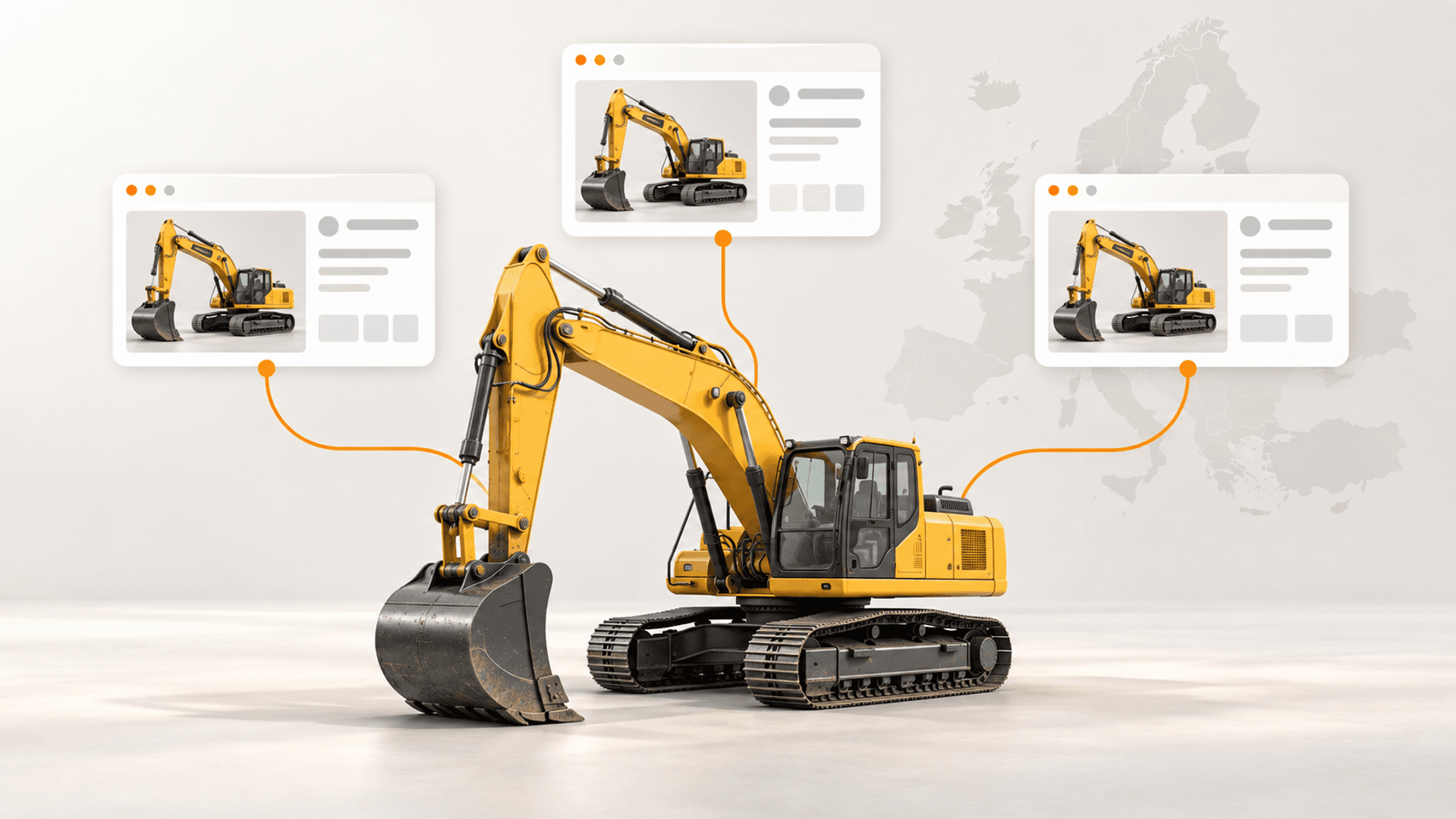
Ask a dealer in Poznan, Lyon or Utrecht where they list used machines and you get the same answer phrased three different ways: "everywhere, more or less." Mascus, OTOMOTO, MachineryZone, Agriaffaires, a national portal, a Facebook group, and the company website. Then ask the follow-up question — which of those actually produced the last five machines you sold? — and the room goes quiet.
That gap between where we list and where we sell is expensive. It is also, in my experience, not really a marketplace problem. It is a publishing and measurement problem wearing a marketplace costume.
The listing tax nobody puts in the budget
Take one used excavator. To get it live across four portals, somebody logs into four back offices, retypes the same specification four times, re-uploads twelve photos four times, translates the description at least twice, and sets a price in each. Call it 35 to 50 minutes per machine when nothing goes wrong. Something usually goes wrong.
Now multiply. A dealer moving 200 used units a year spends roughly 150 to 170 hours a year purely on publishing. At a loaded cost of 30 EUR an hour, that is around 5,000 EUR of administration that buys you nothing — no better photography, no sharper pricing, no faster reply to a buyer who is comparing you against three other yards this afternoon.
The second half of the tax is worse because it is invisible. Prices drift out of sync, so a buyer in Germany sees 68,000 EUR on one portal and 71,500 EUR on another and decides you are either careless or chancing it. Sold machines stay live for weeks, generating calls your sales team has to apologise their way out of. Specs entered by four people on four different days stop agreeing with each other. Each one is a small credibility leak, in a market where trust is most of the sale.
Four questions before you compare platforms
Decide what you are actually buying before you argue about which portal is best.
Where do your buyers physically sit? A Warsaw dealer selling 12-tonne excavators to Polish contractors has a completely different answer from a Rotterdam trader shipping to North Africa. Domestic retail and cross-border export are two businesses, and they are not served by the same listings.
What do you actually sell? Construction, agricultural, forestry and material handling do not have the same audience density on every platform. A portal that is excellent for tractors can be thin for telehandlers.
What does a lead look like when it arrives? A phone number with no context and a structured enquiry with machine, hours and delivery country attached are not the same product, even at the same price.
What is your cost per closed deal, by source? Not cost per listing, not cost per lead. Per deal. Most dealers cannot answer this, which is precisely why the "list everywhere" habit survives.
The three big options, assessed fairly
Mascus
Mascus is the closest thing the sector has to a pan-European shop window. Its strength is reach across borders and its familiarity with international buyers, including traders and exporters who search by category and brand rather than by region. If a meaningful share of your machines leave the country they were sold in, Mascus usually earns its place.
The trade-off is competition. Wide reach means your listing sits beside a lot of similar iron, so photo quality, spec completeness and response time do more work than they do on a smaller portal. Thin listings disappear here.
OTOMOTO
In Poland, OTOMOTO is not a machinery marketplace so much as the default place people look for anything with wheels or tracks. Its advantage is raw domestic traffic and a buyer who is already comfortable with the interface. For dealers whose customer base is Polish contractors, farmers and small fleets, it frequently outperforms specialist portals on volume of genuine local enquiries.
The trade-off is that it is a general marketplace with a machinery section rather than the reverse. Buyers browsing there skew domestic and price-led. If your strategy is high-spec cross-border export, it will not carry that weight on its own.
MachineryZone and Agriaffaires
These sister platforms are the strongest option in the French-speaking market and across Southern and Western Europe, with MachineryZone leaning construction and Agriaffaires leaning agricultural. Multi-language listings and a genuinely European buyer base make them a serious channel for dealers who want reach into France, Spain, Italy and Belgium without opening an office there.
The trade-off is duplication. If you are already on Mascus, a slice of the audience overlaps, and paying twice for the same buyer is easy to do without noticing — which brings us back to measuring by source.
The portfolio that usually works
After watching a lot of dealers arrive at roughly the same shape, here is the pattern that holds up.
- One pan-European channel for reach and export demand.
- One domestic channel where your local buyers already are, chosen by country rather than by habit.
- One category-specific channel if you sell something with its own audience, such as forestry or material handling.
- Your own storefront, always — because it is the only listing you own, the only one that carries no lead fee, and the only one that survives a portal changing its pricing.
That is usually three or four channels, not seven. The dealers who list on seven are rarely reaching more buyers. They are reaching the same buyers more times, at higher cost, with less consistent information.
The real bottleneck is publishing effort, not portal choice
Here is the uncomfortable part. Most dealers cannot run this portfolio properly — not because they picked wrong, but because changing anything is expensive. If updating a price means four logins, prices do not get updated. If marking a machine sold means four logins, it stays live. If testing a fourth portal means another 40 minutes per unit, the test never happens, and the decision is made by inertia instead of evidence.
Flip that around. When a machine exists once in your system, with one set of photos, one price, one specification and one status, and it publishes outward to every channel automatically, the calculus changes. Adding a portal becomes a checkbox instead of a project. Removing an underperforming one costs nothing. Prices stay in sync by default. A machine marked sold on Tuesday morning is off every portal by Tuesday morning.
Then you can finally do the thing that matters: tag every enquiry with its source, follow it through to invoice, and review cost per closed deal by channel every quarter. Do that twice and the "where should we list" argument stops being an opinion. It becomes a number, and the number will probably surprise you — most dealers discover one channel is quietly carrying half the business and another has produced nothing but tyre-kickers for eighteen months.
Where to start this week
Pull your last 20 closed used-machine deals and write the origin next to each one. If more than a quarter say "not sure", that is the first thing to fix, and it is a process fix rather than a software purchase. Then check your live listings across every portal for the same three machines and compare the prices. If they do not match, you have a syndication problem, not a marketplace problem.
This is exactly the gap we built Stalmio to close. One machine record shared across sales, rentals and workshop, priced in EUR with European VAT and cross-border rules handled properly, published to Mascus, OTOMOTO, MachineryZone and Agriaffaires in one click and pulled back the moment it sells, with AI drafting the listing copy in each language so the 40-minute job becomes a 4-minute one. Choose your channels on evidence. Just make sure the cost of changing your mind is close to zero.