Why Heavy Equipment Dealers Need a DMS That Handles Sales, Rental, and Workshop Together
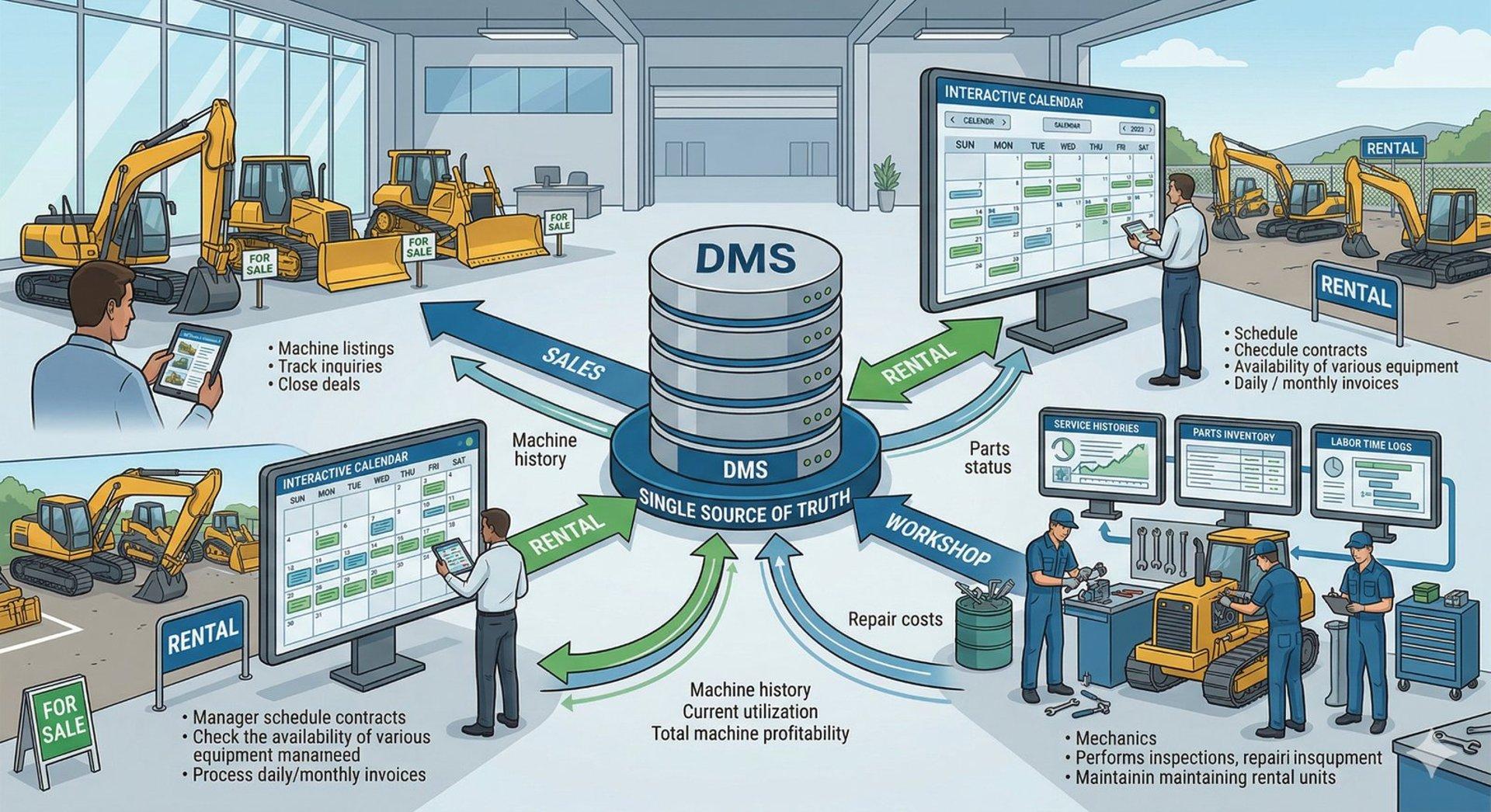
Most heavy equipment dealerships don't run one business. They run three.
There's the sales arm — buying machines, listing them, fielding enquiries, closing deals. There's the rental arm — managing contracts, tracking availability, invoicing by the day or month. And there's the workshop arm — inspecting incoming stock, repairing machines before sale, servicing rental units, handling customer repairs.
Each of these generates revenue. Each touches the same machines. And yet, in most dealerships, each runs on its own tools — or worse, its own spreadsheets — with no real connection between them.
The result is a business that works harder than it needs to, makes decisions on incomplete information, and loses money in the gaps between departments that were never designed to talk to each other.
There is a better way to build this. And it starts with a single, integrated system.
The Problem With Running Three Separate Systems
When sales, rental, and workshop operate in silos, the friction shows up everywhere — often in ways that are so routine they stop feeling like problems.
A machine comes back from a rental contract. Someone needs to tell the sales team it's available. Someone else needs to log the workshop inspection before it can be listed. The photos need updating. The hours have changed. If these three conversations happen across different tools — or don't happen at all — the machine sits idle for weeks while everyone assumes someone else is handling it.
Or consider this: a customer calls asking whether a specific excavator is available to rent next month. The rental team doesn't know it's currently earmarked for sale. The sales team doesn't know the rental enquiry exists. Neither team has visibility into whether the workshop has it scheduled for a repair. Three separate systems mean three separate realities for the same physical machine.
For small and medium-sized dealerships — where the same person often wears two or three hats — this fragmentation isn't just inefficient. It directly costs deals, creates double-bookings, and makes it almost impossible to know, at any given moment, which machines are actually generating revenue and which are just sitting.
The Central Idea: One Machine, Flexible Purpose
The right approach doesn't force a dealer to decide, at the point of purchase, whether a machine is a sales unit or a rental unit. That decision should stay flexible — and it should be changeable at any time, from the machine's own record.
In a properly integrated DMS, every machine in your inventory can be:
- For Sale — listed on marketplaces, visible to buyers, with a quoted price and sales workflow attached
- For Rent — available in the rental calendar, with contract management and utilisation tracking active
- For Sale and Rent simultaneously — listed on the market while also available for short-term rental contracts, with automatic status management to prevent conflicts
This flexibility matters because machines don't always follow a clean path. A unit you bought intending to sell might sit for three months. Rather than letting it depreciate in the yard, you put it on a rental contract to generate income while it waits for the right buyer. When the sale happens, the rental status closes automatically. No manual updates across multiple systems. No risk of renting out a machine that's just been sold.
The machine file is the single source of truth. The business logic follows from whatever status you've set.
How the Three Arms Work Together
Sales and Rental: Shared Inventory, Different Workflows
In an integrated system, the sales and rental teams work from the same inventory. They see the same machines, the same availability, the same status. But their workflows are tailored to what each arm actually needs.
The sales team sees listing status, enquiry history, margin calculations, and quote tools. The rental team sees availability calendars, contract terms, daily and monthly rates, and utilisation data. Neither team has to ask the other what's happening with a machine — the system shows it.
When a machine moves from available to rented, the sales listing can remain active — or it can be automatically paused, depending on how you've set the rules. When the rental contract ends, the machine returns to full availability for both arms without anyone needing to update anything manually.
Workshop and Sales: Every Repair Affects the Price
One of the most underappreciated integrations in a properly built DMS is the connection between the workshop and the sales floor.
Every repair job logged by the workshop — parts, labour, time — flows directly into the machine's cost record. That means the margin calculation your sales team relies on is always current. If a hydraulic repair was completed yesterday, it's already factored into the total cost today. The sales team doesn't need to ask workshop what was spent. The number is there.
This also changes how workshop decisions get made. When the workshop manager can see a machine's current asking price alongside the repair estimate, the question "is this repair worth doing?" has a data-backed answer. Fix it and list it at a higher price. Sell it as-is at a discount. The integrated view makes that a business decision, not a guess.
Workshop and Rental: Maintenance That Protects Revenue
Rental fleets live and die on machine availability. A machine that breaks down mid-contract doesn't just cost the repair — it costs the daily rental rate, the customer relationship, and potentially the next contract.
When the workshop and rental arms are connected, scheduled maintenance can be built into the rental calendar. A machine due for a service in six weeks can have that time blocked out automatically, so the rental team doesn't book a contract that overlaps with the service window. Workshop orders flow from the rental record. Service history attaches to the machine file. Everyone is working from the same operational picture.
Built for SMB Dealers: Why This Matters at Your Scale
Large dealer groups can afford to run separate systems for each arm of the business. They have teams dedicated to integration, IT staff to maintain connections between platforms, and enough margin to absorb the inefficiency.
Small and medium-sized dealerships don't have that luxury. At SMB scale, the person managing rentals is often the same person handling sales enquiries and coordinating with the workshop. Having to log into three different systems — or maintain three different spreadsheets — to get a complete picture of one machine isn't just annoying. It's a structural disadvantage.
An integrated DMS built for SMB dealers removes that disadvantage. It gives a ten-person dealership the operational clarity that a hundred-person operation achieves through dedicated teams and expensive enterprise software. One platform, one login, one view of the entire business.
It also scales with you. Start with sales management. Add rental when you're ready to grow that arm. Activate the workshop module when your service volume justifies it. You're not buying three separate products — you're unlocking different parts of the same system as your business develops.
What an Integrated Day Looks Like
To make this concrete, consider how a typical morning looks in a dealership running an integrated system versus one running separate tools.
Without integration: The owner checks the sales spreadsheet, then logs into the rental tool to see what's coming back this week, then calls the workshop manager to find out which machines are ready. Three separate conversations to build a picture that should be visible in seconds. By the time everything is cross-referenced, something has already changed.
With an integrated DMS: The owner opens one dashboard. Available machines for sale are listed with current margin and days in stock. Rental contracts ending this week are flagged, with the machines automatically queued for workshop inspection. Work orders from the workshop show which units are ready to list and which are still being prepared. One screen. Complete picture. Five minutes instead of forty-five.
The Real Competitive Advantage
The dealers who run integrated operations don't just work more efficiently. They make better decisions — because they're making them with complete information.
When you know a machine has generated six months of rental income before being sold, you understand its true return on investment. When you know the workshop costs on a specific model consistently exceed the margin improvement they generate, you stop over-investing in refurbishment for that category. When you can see utilisation rates across your rental fleet alongside sales velocity in your stock, you know which machines to buy more of and which to exit.
That kind of operational intelligence isn't available when your three arms are running on separate tools. It only emerges when everything is connected.
For SMB dealers competing against larger operations with more resources, this is where the advantage lives — not in having more machines or more staff, but in having a clearer picture of every machine in the business and the ability to act on it faster.
One System. Three Arms. One Source of Truth.
Heavy equipment dealerships are complex businesses. The machines move between sale, rental, and workshop constantly. Revenue comes from multiple streams. Decisions made in one arm affect the others every day.
A DMS that handles only one of those arms forces you to build the connections yourself — in spreadsheets, in conversations, in manual updates across multiple tools. That works, until it doesn't.
A DMS built to support all three arms, with a single machine file at the centre and flexible status controls that let you decide what each machine is for at any given moment, doesn't just reduce admin. It changes how the business is run.
Sales, rental, and workshop aren't three separate businesses. They're three arms of one. The software should work the same way.