
Workshop Process and Work Order Management: A Practical Guide for SMBs
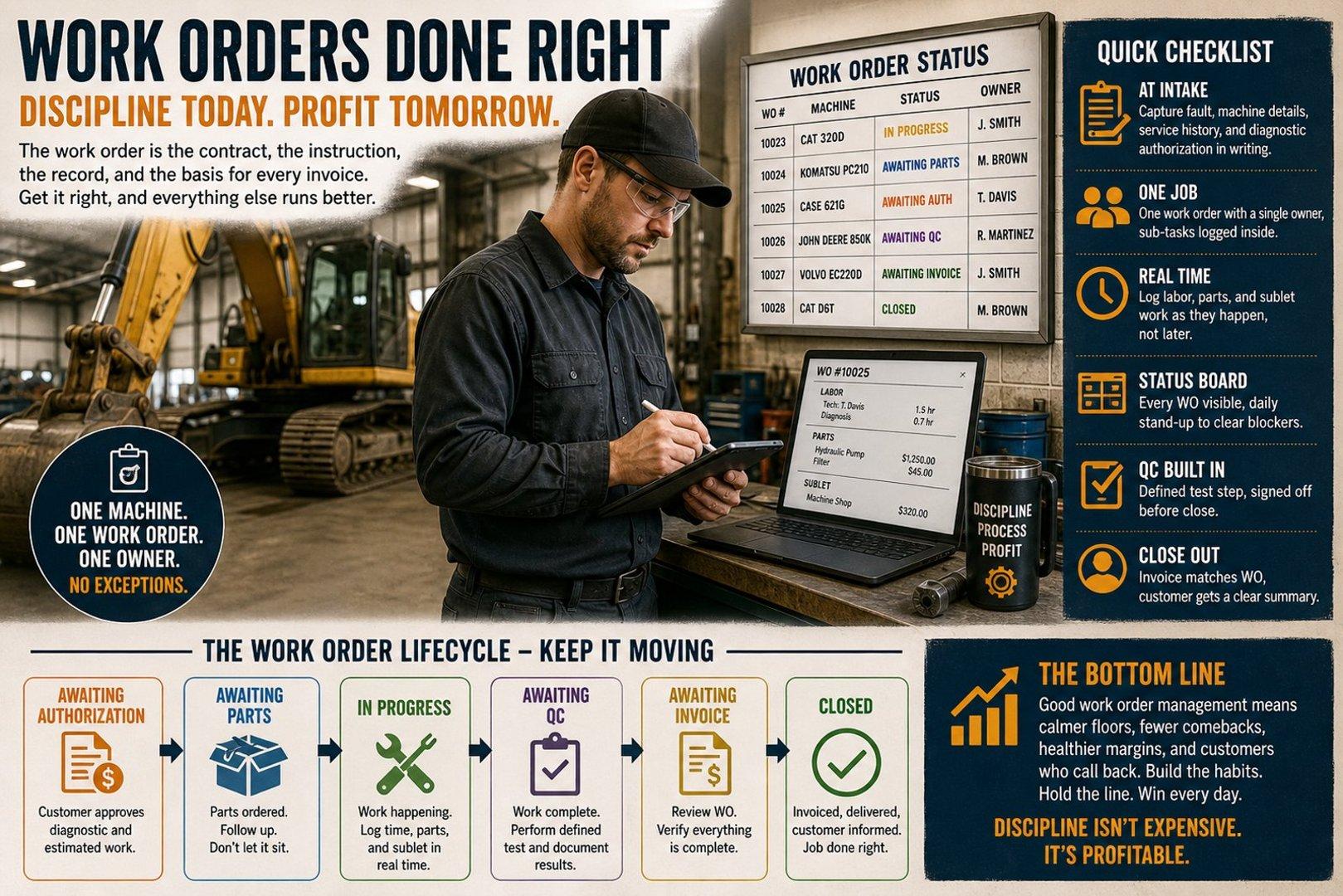
For small and mid-sized businesses running a heavy equipment workshop — whether it's an in-house fleet shop, a third-party repair operation, or a hybrid that does both — the work order is the single most important document in the building. It's the contract with the customer, the instruction set for the technician, the record for the warranty claim, and the basis for every invoice that goes out the door. When the work order process is sloppy, every downstream problem follows: jobs sit waiting on parts no one ordered, technicians chase missing information, machines leave without being properly tested, and customers dispute charges they don't recognize.
The good news is that workshop discipline isn't expensive. It's a set of habits, applied consistently. Here's how to think about it.
The work order starts before the machine arrives
Most SMB workshops treat the work order as something that gets opened when a machine rolls onto the floor. That's already too late. By the time the machine is on the lift, the technician should already know what's wrong, what's been tried, what parts are likely needed, and how the customer wants to be billed.
A good intake process captures four things before the machine is scheduled in:
- The reported fault in the customer's own words
- The machine's identifying details (make, model, serial number, hour meter reading)
- The service history, if you've worked on it before
- A clear, written authorization for diagnostic time
That last item is where workshops bleed money. If you don't have written authorization to spend two hours diagnosing the problem, you'll either eat that time or fight the customer over it later.
One job, one work order, one owner
A surprising number of workshops let work orders multiply on the same machine — one for the original complaint, another for something the technician noticed, a third for a part that came in late. This makes invoicing a nightmare and makes it nearly impossible to track true job profitability.
The discipline is simple: one machine in for service equals one work order, with sub-tasks logged inside it. If a new issue is discovered mid-job, it gets added to the existing WO with a separate authorization line, not a brand new ticket. And every work order has one owner — a single technician or service writer responsible for its status from open to close. Shared ownership is no ownership.
Parts, labor, and time logged as they happen
The biggest single drain on workshop profitability is unbilled work. A technician spends 40 minutes diagnosing a hydraulic issue, mentions it verbally, moves on, and the time never makes it onto the invoice. Multiply that by every job, every week, and you've lost a technician's worth of revenue.
The fix is logging in real time, not at the end of the day or — worse — the end of the week. Time clocks against the work order. Parts pulled from the bin scan onto the work order. Sublet work (machining, hose fabrication, specialty diagnostics) gets attached the moment it's authorized. The goal is that at any point in the day, the work order reflects exactly what's been done and what it cost. End-of-day reconstruction is where margin disappears.
Status discipline keeps the floor moving
Every work order should be in one of a small number of clearly defined states: awaiting authorization, awaiting parts, in progress, awaiting QC, awaiting invoice, closed. The number of states matters less than the discipline of moving work orders through them visibly — on a whiteboard, a job board, or a workshop management system. When a WO sits in "awaiting parts" for four days because no one followed up with the supplier, that's a status problem, not a parts problem.
A daily fifteen-minute stand-up around the board catches this. The service manager goes work order by work order: what's blocking it, what's the next step, who owns the next step. It's not glamorous, but workshops that do this consistently have throughput that workshops without it can't match.
QC is part of the job, not a courtesy
Heavy equipment that leaves the workshop without proper testing is a liability that comes back hard — comebacks erode customer trust, cost twice the labor to fix, and often involve warranty disputes. Yet QC is the step most commonly skipped when the shop is busy.
Build QC into the work order itself. The job isn't done when the technician thinks it's done; it's done when a defined test is completed and signed off. For a hydraulic repair, that might be a pressure test under load. For an engine job, a run-up to operating temperature with diagnostics connected. The QC step takes thirty minutes and saves a return visit that costs four hours.
Close the loop with the customer
The work order doesn't end when the machine leaves. The invoice should match the WO line by line, with no surprise charges, and the customer should receive a brief summary of what was actually done — fault found, parts replaced, tests performed, recommendations for future service. This sounds like extra work; it's actually the cheapest customer retention tool a workshop has. Customers who understand what they paid for don't dispute invoices, and they come back for the recommended work.
A quick checklist for the workshop wall
- At intake: capture fault description, machine details, service history, and diagnostic authorization in writing.
- One job: one work order with a single owner, sub-tasks logged inside.
- Real time: log labor, parts, and sublet work as they happen, not later.
- Status board: every WO visible, daily stand-up to clear blockers.
- QC built in: defined test step, signed off before close.
- Close out: invoice matches WO, customer gets a clear summary.
The bottom line
Work order management isn't really about software, though good software helps. It's about treating the work order as the central artifact of the workshop and refusing to let it get out of sync with reality. Workshops that do this run with calmer floors, fewer disputes, healthier margins, and customers who actually call back. Workshops that don't spend their week firefighting problems they created themselves at intake.
Build the habits, train the team on them, hold the line — and the workshop stops being chaos with a roof on it and starts being the predictable profit center it's supposed to be.